Blog
We feature diverse physician voices, success stories, and expert insight on navigating the business of healthcare. Read how private practices, administrators, and clinicians across the country are thriving and how you can elevate your practice and stay ahead of industry shifts.
Unlocking the Next Level of Value-Based Care
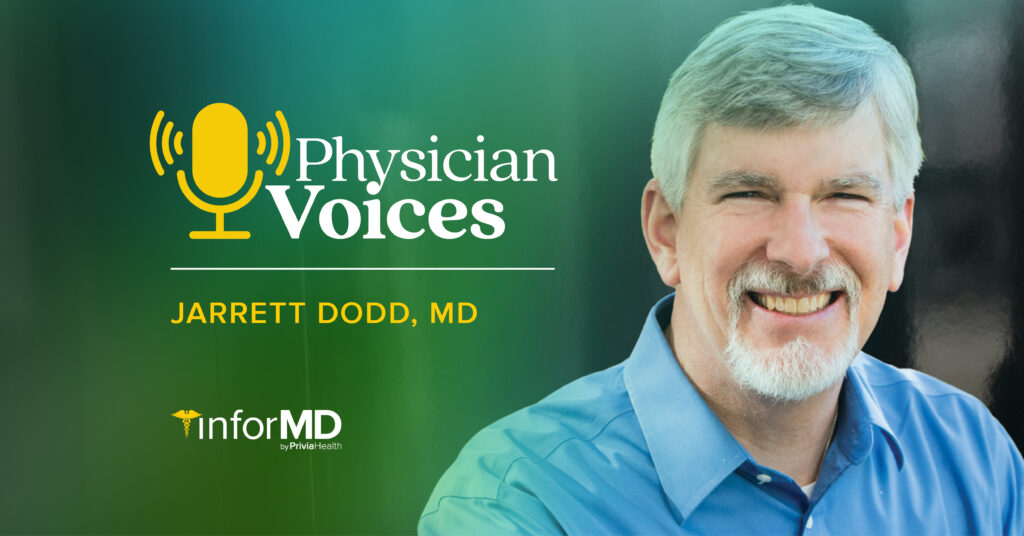
In our “Physician Voices” podcast series, doctors share their unique stories, expert perspectives, and helpful insights. In this episode, we welcome Jarrett Dodd, MD, a family medicine physician and Chief Medical Officer of Privia Medical Group — Mid-Atlantic's Virginia market. We discuss why practices that are already involved in — but want to do more with — value-based care should consider their options.
This excerpt of our conversation is edited for length and clarity. You can listen to the full episode below and find us on your preferred platform.
What was it about Privia's model and support for value-based care that influenced your practice's decision to join?
We'd realized that we didn't have the data analytics we needed to properly track how we were doing in a value-based care model. The electronic health record (EHR) we were on before joining Privia was not very robust in that area. Privia did a phenomenal job of supporting us in the transition to Athena. They had a great implementation team and trainers. They allowed us to individualize parts of the EHR to fit our way of doing things as best we could.
And that actually led to an opportunity for me to get involved in their National Clinical IT Advisory Council (NCITAC). We wanted to make sure the EHR worked in a way that made sense for physicians, and we had ideas to contribute, so I was able to secure a position on the NCITAC. I guess if you make enough suggestions, somebody says, "Hey, you want to come on board?" Next thing you know, you're part of the decision-making process. And that really only happens if you're in a physician-led organization.
In addition to all of that, Privia made it so we could maintain our autonomy. We didn't have to sell our practice or to turn ourselves over to a hospital system. We could collaborate with Privia in a way that still allowed us to guide how things go, which was extremely attractive to us.
How have Privia's physician-organized delivery "POD" meetings helped improve your success in value-based care?
You have physicians from different practices, not just your own, sit in a room and discuss questions like, “How do we address the barriers and trials that we have in front of us? What are we trying to accomplish? How can we do so in a way where everyone benefits and we're all rowing in the same direction?" All of the doctors at those meetings are pretty much in the same boat. Different practices certainly have different challenges, but that leads to different ways of solving problems. When you get a whole bunch of pretty smart people in a room talking about what works for their groups, you start asking yourself, "How can we adapt what they're doing to our practice style?" That allows for great innovation, and for us to support one another.
To give an example, we had a very low rate of Annual Wellness Visits (AWVs) and all kinds of pushback — "We don't have time," "They're not getting scheduled correctly," that sort of thing. But there was one doctor in our POD who was hitting it out of the park with AWVs. We asked how they were doing it, and they said: “Well, the financial reward for doing AWVs is better, so it makes sense to take that extra bit of time and do them."
That was a very simple thing. The main barrier was us, the doctors, thinking we had to do every aspect of the exam ourselves, which was overwhelming and locked up our circuits, if you will. But we reframed it as a team sport and started getting our care teams more engaged, which also made them feel more valued. Instead of just taking a patient's blood pressure and walking them to the room, they're collecting history and connecting with the patient, which makes them feel more fulfilled. So it's a win-win. We tried this approach, realized it wasn't as hard as we thought it would be, and watched our AWV numbers increase significantly — and remain that way ever since. All from someone in our POD saying, "This is how we do it, and it works for us. Give it a shot."
You're always going to get better buy-in from a group of doctors if you have a physician — someone who's walked the same walk as them — helping guide them as opposed to an administrative person who has never spent eight hours in an exam room seeing patients all day. You get to know one another. You start to realize that you're not in this alone. You've got colleagues who are facing the same challenges you're facing. That's huge. Having that peer counseling and support is super important. It just works better that way.
Learn how Privia's physician-led accountable care organizations drive success in value-based care.
Jarrett Dodd, MD, is a board-certified family medicine physician in Lynchburg, Virginia, where he was born and raised. He has worked with patients of all ages but has come to especially enjoy working with seniors. He is passionate about helping seniors achieve the health that will allow them to thrive in their golden years.