






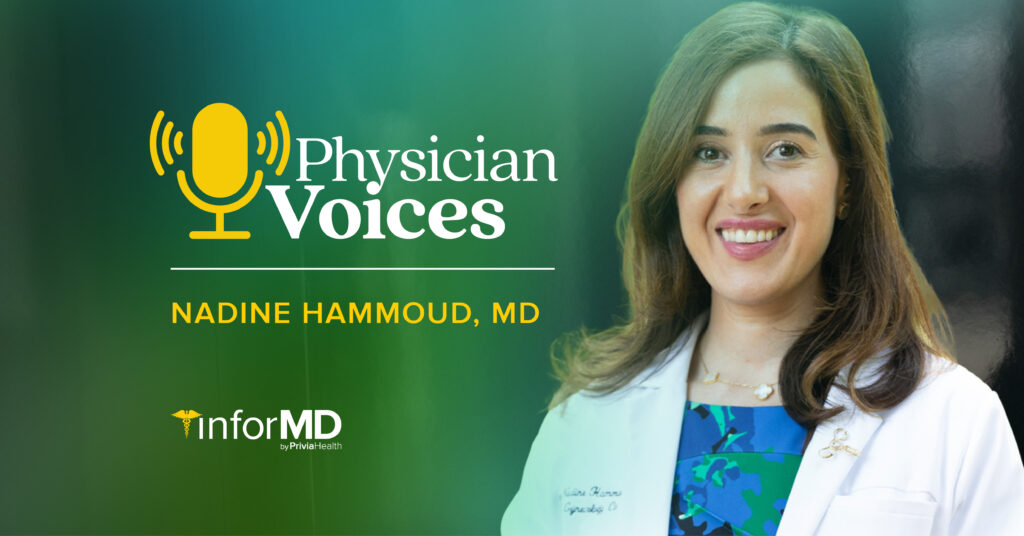
In our “Physician Voices” podcast series, doctors share their unique stories, expert perspectives, and helpful insights. In this episode, we welcome Nadine Hammoud, MD, owner of Elite Gynecology Center in Fairfax, Virginia.
Our conversation highlights the advantages of going into private practice after residency, like having the autonomy to refine your style of medicine and define your career, a community of experienced doctors to learn from, and admin support so you can focus on building relationships with your new patients.
This excerpt of our conversation is edited for length and clarity. You can listen to the full episode below and find us on your preferred platform.
After spending your first few years out of residency as an employed clinician at a private practice, how did you decide to take the leap and launch your own? What were you feeling at that time, and what made you feel ready?
I had a good experience with my prior private practice, and I felt that it was the time for me to grow. It was a mixture of apprehension and excitement, but after a lot of thought and discussion with my peers, colleagues, friends, and family, I felt that it was actually a good step for me to venture on my own and start my private practice. It was more of a personal choice; I just wanted to grow. And I actually knew before even launching my practice that I would go through Privia, because Privia would guide me through the steps that I need to do to move forward with that decision.
How did Privia help throughout that process, both the transition itself and the months or year after opening your doors?
Privia helped with the logistics to streamline the transition. I’m just one person, I can’t do everything. And, by the way, when I left my previous practice, I didn’t have anything lined up. Most doctors need maybe six months to a year preparing, I actually opened my doors within four months.
They helped with the credentialing, pro forma, business planning, electronic medical record, and a website to reach out to patients. Most importantly, I already had their network of doctors for referrals, and I was familiar with the platform. That really helped reduce the “I don’t know what I don’t know” while instilling confidence in my vision to ground myself when times are difficult, which — with any big transition, regardless of how much support I might have — is often there, right?
And I had a community of doctors since I already was established with Privia from my prior practice. So I was very blessed and honored that they would still refer to me at my new practice. They also shared a lot of wisdom with me regarding how to start the practice and what to look for, all those tiny things that medical school doesn’t prepare us for, unfortunately. I also had a one-on-one practice consultant for whenever I wasn’t sure about something. I could just message her or anyone in Privia and get a response, which was really amazing, honestly.
Learn how Privia can support your career during and after residency.

Related Articles
How to Keep Your Patients From Skipping Mammograms
Kristin Schraa, MD, with Virginia Women’s Center shares how women’s health providers can encourage patients ...
3 Ways Healthcare Can Integrate Behavioral Health and Primary Care
Integrating behavioral health with primary care can lead to better patient outcomes — but how ...
How Can Physicians Support Postpartum Mental Health?
On average, 13 percent of mothers in the United States will develop symptoms of postpartum ...
Engaging Patients in Annual Mammograms
Studies show that a little over 66 percent of women aged 40 and older get ...
What Do Medicare-Aged Patients Want in Their Healthcare?
Within the next 20 years, 20 percent of Americans will be 65 or older. It ...
#TBT: Population Health and Primary Care Providers
In celebration of National Primary Care Week (October 1–5), we are sharing one of our ...